Table of Content
Table of Content
How Does Card Cashback Work?What Is Cashback on Card Purchases? What Counts — and What Doesn'tHow Is Cashback Calculated on Card Purchases?The European Cashback Landscape: Real Rates, Real TermsFlat-Rate vs Category-Based Cashback: Which Is Better?Is Cashback Different from a Discount?When Do Users Usually Receive Cashback?Cashback and Multi-Wallet Budgeting: A Practical CombinationHow to Maximise Your Everyday CashbackCan Cashback Help with Everyday Spending?Summary
Table of Content
Card Cashback Explained: How Cashback Works on Everyday Card Purchases
You buy groceries, fill up the car, pay for a flight, grab lunch — and every time, a small percentage of what you spent quietly lands back in your account. No coupons. No stamps. No minimum spend. That's card cashback in a nutshell: a percentage of your everyday card purchases, returned to you in real money.
You buy groceries, fill up the car, pay for a flight, grab lunch — and every time, a small percentage of what you spent quietly lands back in your account. No coupons. No stamps. No minimum spend. That's card cashback in a nutshell: a percentage of your everyday card purchases, returned to you in real money.
But how does cashback actually work? Who's paying for it? What counts as a "qualifying purchase" — and what doesn't? Is it genuinely free money, or is there a catch? And in Europe, where cashback rates are famously tighter than in the US, is it even worth caring about?
This article covers all of it — the mechanics, the maths, the fine print, and the practical strategies for getting the most cashback on everyday purchases without changing how you spend.
How Does Card Cashback Work?
Every time you use a payment card to buy something — in a shop, online, at a restaurant, at a petrol station — the merchant pays a processing fee on that transaction. This fee is called the interchange fee, and it's split between several players: the card network (Mastercard, Visa), the payment processor, and the card issuer (the company that issued your card).
Within the EU, interchange fees are capped by Regulation (EU) 2015/751, the caps are:
- 0.2% of the transaction value for consumer debit and prepaid cards
- 0.3% of the transaction value for consumer credit cards
These caps apply to all card-based payment transactions across the EU and EEA. They're significantly lower than in the US, where interchange fees can run 1.5–3.5% — which is exactly why American cards routinely offer 2–5% cashback while European cards tend to be more modest.
Card cashback is typically funded from the issuer's share of this interchange revenue, sometimes supplemented by the loyalty program provider. So when you earn 0.5% cashback on a €100 purchase, that €0.50 comes from the fees the payment ecosystem already generates on your transaction. The merchant isn't paying extra. The issuer is sharing a portion of what they earned.
This matters because it answers the instinctive question: is cashback free money? In the sense that you're not paying for it directly — yes. Nobody's adding a surcharge to your purchase. The cashback is a redistribution of fees that already exist, designed to incentivise you to use your card more often (which generates more interchange revenue for the issuer). The catch-free model works because everyone in the chain benefits from higher transaction volume.
What Is Cashback on Card Purchases? What Counts — and What Doesn't
This is the single most important section to read before you rely on cashback rewards, because the definition of "card purchase" is narrower than most people assume.
Cashback on card purchases applies to standard point-of-sale transactions — meaning you're buying something from a merchant. This includes:
horizontal scroll
| Transaction Type | Qualifies for Cashback? | Why |
|---|---|---|
| Supermarket / grocery shopping | ✅ Yes | Standard merchant purchase |
| Restaurant / café | ✅ Yes | Standard merchant purchase |
| Online shopping (Amazon, Zalando, etc.) | ✅ Yes | Card-not-present merchant purchase |
| Petrol / fuel stations | ✅ Yes | Standard merchant purchase |
| Subscription services (Netflix, Spotify, etc.) | ✅ Yes | Recurring merchant charge |
| In-app purchases | ✅ Yes | Merchant purchase via card |
| Travel bookings (flights, hotels, trains) | ✅ Yes | Standard merchant purchase |
| Clothing, electronics, homeware | ✅ Yes | Standard merchant purchase |
| ATM cash withdrawals | ❌ No | Not a purchase — it's a cash advance/withdrawal |
| SEPA / bank transfers | ❌ No | Financial transaction, not a merchant purchase |
| Cryptocurrency purchases | ❌ No | Classified differently from merchant transactions |
| Card-to-card transfers | ❌ No | Peer-to-peer transfer, not a merchant payment |
| Account fees / service charges | ❌ No | Not a purchase |
| Currency conversion fees | ❌ No | Service charge, not a merchant payment |
The technical rule: if the transaction goes through the card network with a Merchant Category Code (MCC) — a four-digit code that identifies the type of merchant — it's a card purchase and almost certainly qualifies. If it's classified as a financial operation (withdrawal, transfer, fee), it doesn't.
With Blackcat, the 0.5% cashback on card purchases follows exactly this logic: it applies to all card purchases and does not cover cash withdrawals, transfers, or cryptocurrency operations.
How Is Cashback Calculated on Card Purchases?
The maths is straightforward. For a flat-rate cashback card:
Cashback = Transaction amount × Cashback rate
So on a €47.50 grocery shop at 0.5% cashback: €47.50 × 0.005 = €0.24 cashback on that single transaction.
That number looks small — and it is, per transaction. But cashback isn't about individual purchases. It's about cumulative volume across every card purchase you make, over months and years.
Let's model three realistic spending levels for a European cardholder:
horizontal scroll
| Monthly Card Spend | Cashback Rate | Monthly Cashback | Annual Cashback | 5-Year Cashback |
|---|---|---|---|---|
| €800 (modest spender) | 0.5% | €4.00 | €48 | €240 |
| €1,500 (average household) | 0.5% | €7.50 | €90 | €450 |
| €2,500 (active card user / household) | 0.5% | €12.50 | €150 | €750 |
According to Eurostat's 2024 household consumption report, EU household final consumption grew by 1.5% in real terms in 2024, with particularly strong growth in spending on information and communication services. The average euro area inhabitant held 2.5 payment cards as of H1 2025, per ECB payments statistics. As more spending shifts from cash to cards — the ECB's SPACE 2024 study shows cash dropped from 59% to 52% of POS transactions between 2022 and 2024 — the base of card-eligible spending only grows.
For a two-person household each spending €1,500/month on their cards: that's €180/year or €900 over five years — earned entirely from spending that would have happened anyway.
The European Cashback Landscape: Real Rates, Real Terms
Because of the EU's interchange cap, European cashback rates are structurally tighter than in the US. Here's what the major European fintechs actually offer in 2026:
horizontal scroll
| Provider | Cashback Rate | What Qualifies | Monthly Fee | Key Conditions |
|---|---|---|---|---|
| Blackcat | 0.5% flat | All card purchases | €0 | Free plan. Paid monthly in euros. No categories. No activation. Details |
| Revolut Metal | 0.1% in Europe, 1% outside Europe | Card payments | €12.99/month | Highest-tier plan only. Source: The Poor Swiss, April 2026 |
| N26 Metal | Not standard; partner offers | Selected partners | €16.90/month | Focus on insurance, not cashback. Source: The Poor Swiss, April 2026 |
| Vivid Money | Up to 2% on selected brands | Rotating categories | €0–€9.90 | Categories change. Requires tracking. Source: Freenance, April 2026 |
| Curve | Partner cashback | Selected retailers | Varies | Not universal; requires Curve layer on top of existing card. Source: Curve blog |
A few things stand out. First, most European providers gate cashback behind a paid subscription. Revolut's 0.1% in-Europe cashback requires €12.99/month (€155.88/year). N26 Metal costs €16.90/month. At those prices, you need substantial card spend just to break even.
Second, category-based or partner-based cashback requires effort. You need to know which brands are in this month's rotation, or which retailers are in the partner network. If your spending doesn't align with the bonus categories, your effective rate drops below the headline number.
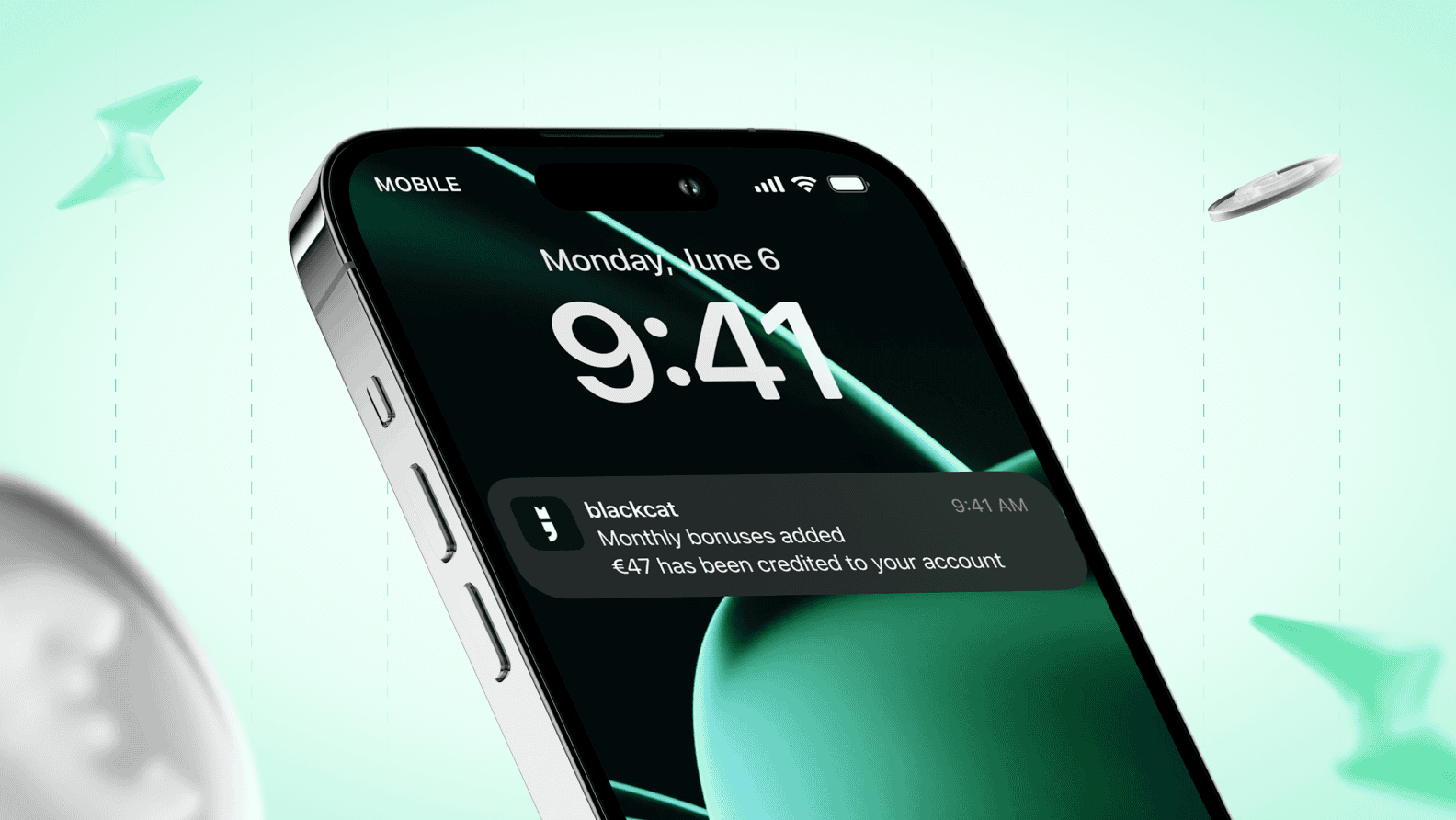
Third, flat-rate cashback on all card purchases with no monthly fee is the simplest, most predictable option. With Blackcat's cashback rewards program, every card purchase earns 0.5%, paid monthly in euros, on the free plan. No categories to track. No subscription to offset.
Flat-Rate vs Category-Based Cashback: Which Is Better?
Flat-rate (everyday cashback): same percentage on every qualifying card purchase. Typically 0.5% in Europe. Zero thought required — you use your card, you earn.
Category-based (shopping cashback): higher rates on specific merchant types (dining, travel, fuel, etc.) with lower or zero rates on everything else. Headline numbers are flashier (2–5%), but the effective return depends on your spending distribution.
horizontal scroll
| Factor | Flat-Rate Cashback | Category-Based Cashback |
|---|---|---|
| Typical European rate | 0.5% on everything | 1–5% on select categories, 0–0.5% on rest |
| Effort required | None | Track categories, activate offers |
| Best for | Diversified, everyday spending | Concentrated spending in bonus categories |
| Predictability | High — same rate every month | Variable — depends on category alignment |
| Risk of ''dead'' spend | None — everything qualifies | High — non-bonus spend earns little or nothing |
| Monthly fee typical? | Often free | Often requires paid plan |
When flat-rate wins: your spending is spread across groceries, dining, transport, subscriptions, shopping, and travel — which describes most European households. Every euro spent earns the same return.
When category-based wins: you spend heavily and consistently in a specific area (e.g., a frequent business traveller whose dining and hotel spend dominates their card usage) and the bonus categories align with that pattern month after month.
For most people, flat-rate everyday cashback is the better deal. It's predictable, requires no management, and rewards every purchase equally.
Is Cashback Different from a Discount?
Yes — and understanding the difference is important for how you think about it.
A discount reduces the price of something before you buy it. You see a lower number at checkout. It's tied to a specific product or merchant, and it incentivises you to buy that particular thing.
Cashback returns a percentage after you buy anything. The price you pay at the merchant is unchanged. The return comes later — from your card issuer, not from the merchant. It doesn't influence what you buy or where you buy it. It rewards the act of paying with your card, regardless of what you're purchasing.
This distinction matters because cashback should never change your spending behaviour. A discount makes a specific product cheaper, so it might rationally tip a purchasing decision. Cashback, on the other hand, applies to everything — so buying something you don't need "because you'll get cashback" means spending €100 to earn €0.50. That's not a reward; it's a loss of €99.50.
The best way to think about cashback: it's a dividend on spending you'd do anyway. Not a reason to spend more.
When Do Users Usually Receive Cashback?
Payout timing varies by provider, and it matters more than you'd think.
horizontal scroll
| Payout Schedule | What It Means | Example Providers |
|---|---|---|
| Monthly, automatic | Cashback from the previous month's purchases lands in your account without any action | Blackcat |
| Quarterly | Accumulated over three months, then paid | Some traditional bank cards |
| On-demand redemption | You must manually redeem when you hit a minimum balance (e.g., €25) | Some points-based programs |
| Annual | Once per year, often tied to account anniversary | Some premium credit cards |
| Points conversion | Earned as points; you convert to cash/vouchers at a variable rate | Revolut, some airline cards |
Monthly, automatic, in euros is the gold standard. It means your cashback is liquid, usable, and compounding (you can spend or save it immediately). With Blackcat's rewards program, that's exactly how it works: cashback is calculated on your card purchases and paid monthly, in euros, directly to your account. No points. No minimum threshold. No conversion step.
Cashback and Multi-Wallet Budgeting: A Practical Combination
Here's where card cashback becomes part of a broader personal finance system rather than just a passive perk.
If your payment provider supports multiple wallets — separate compartments for different spending purposes, each with its own card — you gain two things simultaneously:
- Budget visibility. You know exactly how much you've allocated to groceries, entertainment, travel, and savings — and how much you've spent in each category.
- Cashback tracking by category. Because each wallet has its own card, you can see which spending categories generate the most cashback.
With Blackcat's wallet with card system, you create unlimited wallets, each with its own IBAN and optional card. Your groceries wallet has its own cashback payment card. Your entertainment wallet has another. Each earns cashback independently on its card purchases. A dedicated cashback app like Blackcat makes this tracking effortless.
How to Maximise Your Everyday Cashback
1. Use your card for everything. The biggest lever is transaction volume. Every payment you make in cash, via direct transfer, or through a non-cashback method is cashback left on the table. Groceries, coffee, subscriptions, transport, fuel, online shopping — all of it should go through your cashback payment card.
2. Know the exclusions. ATM withdrawals, SEPA transfers, crypto purchases, and fees don't qualify. Don't be surprised when they don't earn cashback — be intentional about using the right payment method for each transaction type.
3. Consolidate spending on one card. If you split your purchases across three cards from three providers, your cashback is diluted. Pick the card with the best all-round terms and route as much spend through it as possible.
4. Check if your provider charges a monthly fee. If your card costs €10/month to hold, that's €120/year you need to earn back in cashback before you're in net positive territory. On a 0.5% rate, that means €24,000/year in card spend just to break even. A free card with the same rate is profitable from the first transaction.
5. Don't let cashback change your behaviour. This is worth repeating. Cashback rewards existing spending. The moment you buy something you don't need because "at least I'll get cashback," you've lost far more than the fraction of a percent you'll earn back.
6. Stack with other account benefits. If your provider offers a rewards program with multiple options — cashback, a p.a. reward on balance, or category-specific bonuses — use the one that fits each wallet's purpose. Spend wallets earn cashback. Savings wallets earn the balance reward. That's two streams of return from the same account.
Can Cashback Help with Everyday Spending?
Absolutely — but with realistic expectations. At 0.5%, card cashback won't cover your rent or transform your finances. What it does is provide a consistent, effortless return on spending you'd do anyway. Over time, the numbers compound into something tangible:
- A single person spending €1,500/month earns €90/year — enough for a nice dinner, a weekend getaway fund, or a year's worth of streaming subscriptions.
- A household spending €3,000/month earns €180/year — close to a return flight within Europe or several months of utility bills.
- Over 5 years, that household has earned €900 — from money that was being spent regardless.
The key is that this requires no effort, no behaviour change, and no fees (on the right card). It's the financial equivalent of finding coins in the couch — except it happens reliably, every month, and adds up to real money.
Summary
Card cashback is one of the simplest financial tools available: use your payment card for everyday purchases, and a percentage comes back to you. In Europe, flat rates of around 0.5% are standard, structured around the EU's interchange fee regulations. Cashback applies to standard merchant transactions — not withdrawals, transfers, or crypto — and the best programs pay monthly, in euros, with no minimum threshold and no subscription fee.
The smartest approach: pick a cashback rewards card with no monthly fee and a flat rate on all card purchases, use it as your default for everything, combine it with a multi-wallet system for budgeting, and let the returns accumulate. It won't make you rich. But it will consistently give you something back from money you were going to spend anyway — and over years, that adds up to something worth having.
The bonus payment is a part of the loyalty program provided by Baltic Technology Solutions OÜ. Detailed terms and conditions can be found at https://baltictechsolutions.com/loyalty-program-terms-and-conditions.
Blackcat is issued by Papaya, Ltd. Papaya, Ltd. is licensed by the Malta Financial Services Authority as an Electronic Money Institution (EMI). Registration number C55146. Client funds are safeguarded in accordance with applicable legislation. Funds held in e-money accounts are not covered by the Depositor Compensation Scheme. Standard service and transaction fees may apply. See the tariff schedule on blackcat.app.
FAQ: Card Cashback Explained
How does card cashback work?
When you pay with a card, the merchant pays a processing fee (the interchange fee). Your card issuer receives a share of that fee and returns a percentage to you as cashback. In the EU, interchange fees are capped at 0.2% for debit and 0.3% for credit cards under Regulation (EU) 2015/751. Cashback is funded from this existing fee structure — it doesn't cost you anything extra.
Which purchases qualify for cashback?
Standard merchant transactions qualify: groceries, restaurants, online shopping, fuel, subscriptions, travel bookings, clothing, and electronics. Any payment that goes through the card network with a Merchant Category Code (MCC) is typically eligible. Financial operations — ATM withdrawals, bank transfers, cryptocurrency purchases, and account fees — do not qualify.
Does cashback apply to transfers or cash withdrawals?
No. Does cashback apply to cash withdrawals? It does not. Cashback on card purchases applies specifically to merchant transactions — when you buy something from a shop, website, or service provider. SEPA transfers, wire transfers, peer-to-peer payments, and ATM cash withdrawals are classified as financial operations, not purchases, and are excluded from cashback.
How is cashback calculated on card purchases?
For flat-rate cashback: transaction amount × cashback rate. On a €50 purchase at 0.5%, you earn €0.25. The calculation applies to every qualifying card purchase individually, and the total is accumulated over the payout period (typically one month). There is no rounding trick — every cent of spend contributes.
When do users usually receive cashback?
This varies by provider — when is cashback paid depends on the program. The best programs pay monthly, automatically, in euros. Some pay quarterly or annually. Others accumulate points that require manual redemption, sometimes with a minimum balance threshold. Monthly automatic payouts in euros — with no minimum and no conversion — are the most practical format.
What should I check before using a cashback card?
Six things: the cashback rate and whether it's flat or category-based; the payout method (euros vs points, monthly vs quarterly); which transactions qualify; whether there's a monthly or annual fee; what other features the account includes (multi-wallet, SEPA, credit-grade card); and how transparent the terms are.
Is cashback different from a discount?
Yes. A discount reduces the price at the point of purchase and is tied to a specific product or merchant. Cashback is returned after the purchase, calculated as a percentage of the total, and applies to all qualifying card transactions regardless of what you buy or where. Cashback rewards the act of paying by card; a discount rewards buying a specific item.
Can cashback help with everyday spending?
Yes — as a consistent, effort-free return on money you're already spending. At 0.5% on €1,500/month in card purchases, you earn €90/year. Over five years, that's €450 per person. It won't transform your finances, but it provides a reliable, compounding return that requires no behaviour change and no additional cost on a fee-free card.