
Table of Content
Table of Content
Table of Content
Multiple Accounts: IBANs and Wallets in One App
Most people end up with multiple bank accounts by accident: one left over from a first job, a joint one for the household, a third opened for a loan and never closed. Money set aside for rent should not quietly fund a weekend. What has changed is that separation no longer requires separate providers.
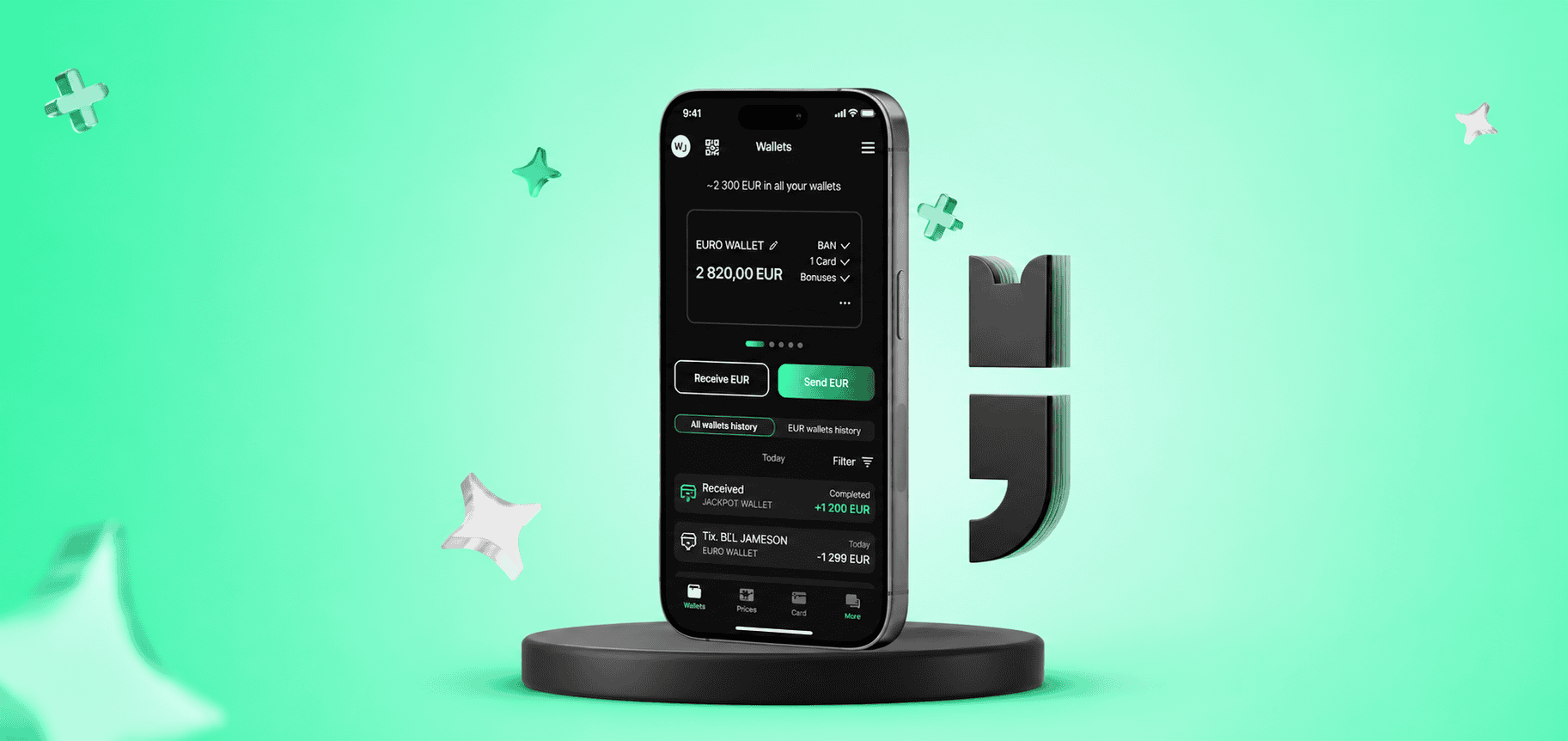
A single app can now hold several euro accounts, each with its own details and transaction history. This article covers what those wallets are, what an IBAN identifies, which wallet pays for your card, and what to check before adding another.
Why do people keep money in separate accounts?
Should you have multiple bank accounts? It depends on what you are trying to prevent. Separation fixes one problem well: money arriving for a specific purpose is being spent on something else before you notice.
Take a freelance translator in Tallinn. Client invoices, the quarterly tax set-aside and the weekly shop land in one balance, so the figure on screen is money she has earned, money she owes the tax authority and money she can spend, added together. Splitting the income into its own account restores the one thing a balance is meant to do.
Opening multiple bank accounts with traditional providers solves that, but adds friction. Having multiple bank accounts with different banks means separate logins, separate apps, separate statements, and often a monthly fee for each.
A multi-wallet setup within a single app aims to achieve the same separation without the overhead, which is why the multi-wallet app has become common.
What an IBAN points to
An IBAN identifies an account, not a person and not an institution. It opens with a two-letter country code indicating where the provider is established, followed by check digits and a national account number, for a total of up to 34 characters.
The Banco de España puts the consumer consequence plainly: if you hold a euro payment account with a bank, a payment institution, or an electronic money institution anywhere in the EU, you can send and receive payments to any other EU account, regardless of the country the IBAN comes from.
Because an IBAN belongs to an account, can one app have multiple IBAN accounts? Yes, where the provider issues them that way.
Blackcat documents a personal IBAN for each euro wallet, issued in your name, so a multiple IBAN account setup is the ordinary arrangement rather than a special case.
Does each euro wallet have its own IBAN? Where it does so, that determines where an incoming payment lands. Think of two post boxes at one address: the post addressed to the first does not turn up in the second, though both are yours.
This is where app wallets differ from generic subaccounts. Some providers split a single euro IBAN account into labelled pots that share a single IBAN. Those pots are a display layer: money sent to that IBAN is credited to the account, and the labels are applied afterwards.
Four things about European account numbers that rarely come up until they cost you money:
SEPA is bigger than the EU. The scheme area covers all 27 EU Member States, three EEA countries and a set of non-EEA territories, according to the European Payments Council's country list.
IBAN length is not fixed. A Spanish IBAN is 24 characters, a Belgian one 16, and the standard allows up to 34. A form that only accepts the local length is a common cause of payment rejection.
E-money has moved off cards and into accounts. Of all euro-area e-money payments in the second half of 2025, 99% were made from e-money accounts rather than from cards storing e-money, according to ECB payments statistics.
Where a wallet differs from a bank deposit
The wallet vs bank account difference is not about features. It is about what your balance legally is. Money in a bank account is a deposit, and deposit guarantee schemes in the EU cover eligible deposits up to €100,000 per person, per institution.
Money in an e-money account is not a deposit. It is electronic money, protected by a different mechanism called safeguarding, which requires the institution to hold client funds separately from its own.
horizontal scroll
| Several wallets in one app | Subaccounts sharing one IBAN | Accounts at different providers | |
|---|---|---|---|
| Own IBAN per pot | Yes, where documented | No | Yes |
| Payments are received straight into a pot | Yes | No one shared an inbound IBAN | Yes |
| Single login | Yes | Yes | No |
| Protection regime | Set by the provider's licence | Set by the provider's licence | Set by each provider's licence |
Table 1. How do the three ways of separating money compare on account details and access? Compiled from Regulation (EU) No 260/2012 and Blackcat’s published Wallets documentation, 2026. Source: Blackcat Help Centre, 2026.
Which wallet does your payment card draw from
Multiple wallets raise a question a single account never does: when you tap at checkout, whose money moves? In Blackcat, it is the main euro wallet.
Card purchases, online payments, and ATM withdrawals are charged to that one, and the help documentation states that a different Euro wallet can be reassigned to the card in the app.
So can I link a card to another wallet to have a practical use?
Someone keeping a travel wallet topped up for a trip can point the card at it for the week, then point it back. A wallet balance not linked to a card is not subject to card transactions.
The flip side: a reassignment you have forgotten about is a declined payment waiting to happen. If a transaction fails, check which wallet the card points to.
Moving money, and what it costs
Transfers inside a system and transfers out of it behave differently. Internal movements never touch the SEPA network, so they settle immediately and, per Blackcat's published terms, carry no charge. A payment to an IBAN outside the country is a SEPA transfer.
horizontal scroll
| Route | Speed | Cost |
|---|---|---|
| Internal, inside the app | Immediate | Free of charge |
| SEPA Credit Transfer | 1–2 business days | Free from Blackcat; the receiving provider may charge |
| SEPA Instant Credit Transfer | Seconds, 24/7 | As above; both providers must support the scheme |
Table 2. Transfer routes and their published handling. Source: Blackcat Help Centre, 2026.
Before adding another wallet, the fees for multiple IBAN accounts are what to check:
- Any monthly or maintenance charge is applied per wallet, not per account.
- Whether outbound SEPA transfers are charged. Under the Instant Payments Regulation, a provider cannot charge more for an instant euro transfer than for a standard one.
- ATM withdrawal fees, which attach to the wallet your card is linked to.
- Any inactivity charge on a wallet you open and then leave empty.
Frequently asked questions
When can having multiple accounts or wallets be useful?
When money arrives for a defined purpose, and you want it kept away from day-to-day spending. Business income, a tax set-aside and shared household costs are the usual cases.
Does every wallet have its own IBAN?
In Blackcat, every Euro wallet comes with a personal IBAN issued in your name. This is not universal: other providers run labelled pots behind one shared IBAN, so check the documentation rather than assuming.
How is a wallet different from a separate bank account?
A bank balance is a deposit covered up to €100,000 by a deposit guarantee scheme. An e-money balance is not a deposit and is instead protected by safeguarding rules that require client funds to be held separately.
Which wallet funds card payments?
The main euro wallet. Card purchases, online payments, and ATM withdrawals are funded by it.
Can I change the wallet linked to my payment card?
Yes. Blackcat's help documentation states that a different Euro wallet can be reassigned to the card in the app.
What fees should I check before adding another wallet?
Per-wallet maintenance charges, outbound SEPA transfer fees, ATM withdrawal fees and any inactivity charge. Check the current tariff schedule, not an older summary.
How do transfers between wallets and external IBANs differ?
Internal movements stay inside the provider’s own system, settle immediately and are free. Anything going to an IBAN elsewhere runs over SEPA: one to two business days as a standard transfer, seconds as an instant one.